

Product Details:
Author(s):
Osode, P ,
Njotini, M ,
Madlanga, MR ,
Nwauche, ES and
Ntlama-Makhanya, N
Year Published:
2024
Edition
1st Edition
Type:
Print | Soft Cover
Language:
English
About this publication
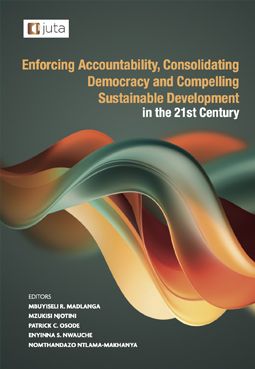
This book and the contents thereof originate from a unique mix of established and emerging scholars as well as high-level industry experts musing and debating some of the most contemporary issues of our time, such as sustainable development as a mandatory minerals extraction industry regulatory norm; the legal status of e-hailing drivers and the companies who own and manage transport service provisioning apps (Uber, Bolt, etc); the problems and prospects of the implementation of the African Continental Free Trade Agreement (AfCFTA); the regulation of applications, uses and impacts of information and communications technologies (ICTs); the unending challenges of applying African Customary Law in the shadow of South Africa’s Constitution and modern constitutionalism and the unique demands and opportunities for law teaching and legal education post-Covid. Furthermore, the book addresses several important themes of both local and global relevance in the areas of democracy and constitutional accountability. Accordingly, it should be an essential reading not just for lawyers, judges, and law students, but for anyone interested in understanding the ways in which the law and related policies are responding to the existential challenges facing society, nationally and globally.
Content
PART 1 INTRODUCTION AND OVERVIEW
Chapter 1 Enforcing Accountability, Consolidating Democracy and Compelling Sustainable Development in the 21st Century: A Prologue
PART 2 TRANSFORMATIVE CONSTITUTIONALISM, SUSTAINABLE AND FOSTERING SOCIAL SOLIDARITY IN SOUTH AFRICA: PROMISE VERSUS REALITY
Chapter 2 The Wild Coast Seismic Survey Judgments: A Case Study on Integrating the Principles of Sustainable Development In Law
Chapter 3 Transformative Constitutionalism in the Context of ESTA – Cases After Daniels v Scribante
Chapter 4 The Impact of the Covid-19 Measures on the Landowner’s Right to Exclude
Chapter 5 Spatial Justice, Sustainable Cities and Gender Issues in Transport in Mangaung
Chapter 6 A Critical Assessment of the Discordance between Poverty and Inequality, Policy, Corporate Social Responsibility, and South African Development Plans
Chapter 7 A Critical Reflection on The State as Trustee or Custodian of South Africa’s Natural Resources: Should Land Be Next?
Chapter 8 A Critical Legal Assessment of South Africa’s Water Infrastructure Compliance with the United Nations Sustainable Development Goal Number Six
PART 3 PROBLEMS AND PROSPECTS OF THE IMPLEMENTATION OF THE AFRICAN CONTINENTAL FREE TRADE AGREEMENT (AfCFTA)
Chapter 9 The African Continental Free Trade Area Agreement
Chapter 10 The Role of Financial Institutions in Facilitating the Implementation of the African Continental Free Trade Agreement
Chapter 11 Understanding the Place of The African Continental Free Trade Agreement in the New Economic World Order: Why Africa Should not be Left Behind
PART 4 RETHINKING GOVERNANCE OF ECONOMIC INSTITUTIONS AND INFORMATION AND COMMUNICATION TECHNOLOGIES TO ENHANCE EFFICIENCY AND COMPEL EQUIT
Chapter 12 Squaring with the Reality of the E-Hailing Drivers’ Arrangements?
Chapter 13 Justifying the Dismissal of Employees for Failure to Comply with Covid-19 Regulations – Refusal to Vaccinate
Chapter 14 “Always on the Verge of Insult and Insubordination” – Reflecting on Shop Stewards’ Conduct During Violent Unprotected Strike in the Light of Nehawu obo Skhosana v Department of Health: Gauteng 2018 ZALCJHB 201
Chapter 15 The Mandate of the Advertising Regulatory Board to Rule on Tobacco Products Advertising Complaints in South Africa
Chapter 16 The Impact of the Covid-19 Pandemic on the Protection of Personal Information on Cloud Computing Services: Lessons Learnt
Chapter 17 Addressing Catfishing: Seeking Civil Recourse for Online Impersonation in Kenya and South Africa
PART 5 PART FIVE: THE JUDICIAL PROCESS, ACCESS TO JUSTICE AND ACCOUNTABILITY IN POST-APARTHEID SOUTH AFRICA
Chapter 18 Contesting the Element of Consent in Sexual Rights Violations in Coko v S (Ca&R 219/2020) [2021] ZAECGHC 91 and R v Gondwe [2021] MWHC 102: The Case of South Africa and Malawi
Chapter 19 The South African Model of Separation of Powers: Does the Executive have Too Much Power?
Chapter 20 Opening the Pandora’s Box of Open Justice: A Critique of Recent Developments in the South African Jurisprudential Approach
Chapter 21 A Proposal for a Post-conviction Remedy for South Africa: Evaluating the Existing Models
PART 6 AFRICAN (LIVING) CUSTOMARY LAW IN THE SHADOW OF CONSTITUTIONALISM (AND MODERNITY)
Chapter 22 The Batswana Customary Law Governing a Child’s Surname Affiliation and the Payment of Tshenyo to the Mother’s Family: The Struggle Between Cultural Relativism and the Universalist Values of the Bill of Rights
Chapter 23 Contextualising Customary Law Adoption in South Africa
PART 7 CONTEMPORARY PERSPECTIVES ON THE USE OF BLENDED LEARNING IN LEGAL EDUCATION
Chapter 24 New Perspectives on the use of Blended Learning at South African Law Faculties
Interest / Benefit to
Lawyers, judges, and law students, but for anyone interested in understanding the ways in which the law and related policies are responding to the existential challenges facing society, nationally and globally.
e-hailing drivers and the companies who own and manage transport service provisioning apps (Uber, Bolt, etc)
Be the first to review “Enforcing Accountability Consolidating Democracy and Compelling Sustainable Development in the 21st Century”
Related products



Reviews
There are no reviews yet.