
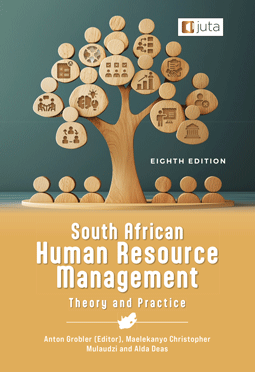

Product Details:
Author(s):
Grobler, A
Year Published:
2025
Edition
8th Edition
Type:
Print | Soft Cover
Language:
English
About this publication
“South African Human Resource Management, now in its eighth edition, answers the ever-growing demand for a human resource management (HRM) compendium, globally but specifically within the South African context. This is even more so in the post Covid-19 phase, which required new HR and organisational skills from the fraternity.
Written by South Africans for South Africans, the book contextualises HRM locally and within the wider African context, and demonstrates why HRM is central to the sustainable development challenges we face.
This update covers contemporary HR trends in South Africa and the SABPP’s National HR Management System Standard and its supporting process of the ongoing development of Professional Practice Standards. It contains cutting-edge information for complete streams of HRM studies, and now includes numerous public-sector examples and connections, making it an indispensable tool for those practising (or aspiring to practise) HRM in public-sector organisations. The book emphasises the broader ‘HRM agenda’, showing its value to working people, organisations and society.
Topics covered include:
• the unique, evolving and challenging context of HRM in South Africa – including the African context
• HRM’s legal conformance challenge, and its ‘performance’ challenge to develop socio-economic inclusiveness
• strategising, designing and planning as ‘preparatory’ HRM work
• sourcing, developing and retaining talent
• developing labour relations that add value
• championing change and transformation in organisations and society
• possible HR implications of digitisation and automation of work, frequently referred to as the Fourth Industrial Revolution
• managing HRM-related information, including reporting on HRM and sustainability
• examples from elsewhere in Africa, which widens the scope and applicability of the book to other parts of the African continent.
This edition is ideal for undergraduate and postgraduate studies at higher education institutions, as well as for human resource practitioners. It is of value to management development and MBA programmes, as it clearly shows that HRM is central to the work of all managers, and to anyone involved and/or potentially interested in the management of human resources on the African continent.”
Content
Preface ix
About the authors x
PART 1:
SETTING THE HRM AGENDA: CONCEPTUAL AND CONTEXTUAL PERSPECTIVES 1
Chapter 1: The challenge of human resource management: an introduction 3
1.1 Human resource management: foundations, definitions and significance 3
1.2 Organisations and management as embedded societal phenomena:
the sustainability challenge of HRM 7
1.3 Open-system perspectives to human resource management 15
1.4 Scope of HRM work 16
1.5 Variables that interplay with HRM: a glimpse of the HRM complexity challenge 21
1.6 HRM requires both managers and specialists 37
1.7 Managing work and people: a brief evolutionary perspective of HRM 39
1.8 Outline of this book 47
Chapter 2: South African human resource management in context 49
2.1 Introduction 49
2.2 South African human resource management in historical context:
synoptic reflections 49
2.3 Snapshots of South Africa’s contemporary socio-political economy in a
global context 70
2.4 Africa and beyond: shifting international competitive landscapes and dynamics 71
2.5 South Africa and its people: some brief contemporary reflections 83
2.6 South Africa’s economic situation: brief observations 94
2.7 Politics, policy and the state: key contemporary challenges and issues 99
2.8 South Africa’s socio-political economy: concluding remarks 102
2.9 Dynamics in South Africa’s fraternity of human resource practitioners:
towards a real profession? 105
2.10 Summary 118
Chapter 3: Beyond conformance: HRM for socio-economic inclusiveness 119
3.1 Introduction 119
3.2 The HRM conformance challenge: South Africa’s legislative framework 120
3.3 From conformance to performance: empowering people and equitable equality 141
3.4 Embracing and managing diversity 161
3.5 Summary 168
PART 2:
PREPARATORY HRM WORK: STRATEGISING,
PERSPECTIVES DESIGNING AND PLANNING 171
Chapter 4: HRM strategies and policies: frameworks for managing
human resources 173
4.1 Introduction 173
4.2 Strategy and strategic management 174
4.3 HRM strategy development: options, issues, choices and processes 182
4.4 Establishing an HRM policy framework 188
4.5 Business planning for HRM 194
4.6 Summary 195
Chapter 5: Designing work, organisations and HRM work 198
5.1 Introduction 198
5.2 Work design 199
5.3 From group-based work to teamwork: an increasingly popular work design option 210
5.4 Organisation design: trends, issues and considerations 216
5.5 Organising HRM work 219
5.6 Summary 231
Chapter 6: Workforce planning 233
6.1 Introduction 233
6.2 Strategic planning and strategic workforce planning 234
6.3 The general nature and process of workforce planning 235
6.4 The purpose and importance of workforce planning 236
6.5 Criteria for effective workforce planning 237
6.6 Factors that influence workforce planning 237
6.7 The responsibility for workforce planning 239
6.8 The workforce planning process 242
6.9 Job analysis 254
6.10 Summary 259
PART 3:
SOURCING WORK TALENT 261
Chapter 7: Recruiting and selecting the right work talent 263
7.1 Introduction to the recruitment of talent 263
7.2 Factors influencing recruitment policy and practice 264
7.3 Recruitment sources and methods 269
7.4 Overview of the recruitment process 274
7.5 Aspects of quality control in recruitment 278
7.6 Finding non-employee workers: temporary employment services 279
7.7 Summary of the recruitment function 279
7.8 Introduction to the selection of talent 279
7.9 Predictors and criteria 280
7.10 Assessing the quality of predictors 281
7.11 Components of an employee selection process 282
7.12 Making the selection decision: fairness is key 291
7.13 Summary of the selection process 295
PART 4:
THE CHALLENGE OF PEOPLE EMPOWERMENT 297
Chapter 8: Effective leadership in the workplace 299
8.1 Introduction to motivation and work 299
8.2 Human motivation: assumptions and their implications 300
8.3 Theories of motivation 305
8.4 Consolidated perspectives on motivation theories and managerial implications 316
8.5 Motivation and work: some specific applied issues 317
8.6 Summary of motivation in the workplace 323
8.7 Introduction to leadership at work 324
8.8 Post-industrial era developments: emergence of an integrative leadership
theory paradigm? 325
8.9 Leadership in South Africa: perspectives reflecting elements of transformation 332
8.10 Diversity and leadership 335
8.11 Summary of leadership in the workplace 338
Chapter 9: Managing, assessing and enhancing work performance 340
9.1 Introduction 340
9.2 Performance management in an organisational context 341
9.3 Developing a performance management system 347
9.4 Components of an effective performance management system 351
9.5 Performance appraisal 354
9.6 Performance appraisal systems: some fundamental requirements 357
9.7 Conducting a performance appraisal 358
9.8 Performance appraisal problems and possible remedies 361
9.9 Performance appraisal methods 365
9.10 Performance issues relating to non-employees 375
9.11 Summary 376
Chapter 10: Managing and developing careers for talent and retention 377
10.1 Introduction 377
10.2 Foundations for effective career management 378
10.3 Some important career-related issues 382
10.4 A framework for career development services in South Africa:
some macro-level perspectives 393
10.5 Career development in the knowledge economy: macro-level issues
and challenges 396
10.6 Career dynamics facing the 21st-century workplace: some general
observations 399
10.7 Careering through the unknown: navigating the impact of the Fourth
Industrial Revolution 401
10.8 Individual and organisational perspectives of careers 404
10.9 Career choice: some theoretical perspectives 405
10.10 Two models of career management 409
10.11 Career development planning 415
10.12 Career development support methods 416
10.13 Summary 421
Chapter 11: Developing South Africa’s human resources: macro-level
perspectives on the agenda and framework 423
11.1 Introduction 423
11.2 National training initiatives 424
11.3 National Skills Development Strategy (NSDS) 429
11.4 The National Qualifications Framework of South Africa 431
11.5 Skills Development Act 437
11.6 Occupational learning programmes 444
11.7 Financing skills development 455
11.8 Managerial implications of the legislation 455
11.9 Adult basic education and training 456
11.10 Summary 458
Chapter 12: Training and developing employees:
organisational-level perspectives 460
12.1 Introduction 460
12.2 Human resource development: concepts, context and goals 461
12.3 Principles and importance of effective HRD practice 465
12.4 The relationship between HRD and other aspects of HRM 466
12.5 A model for systematic training 468
12.6 Management development and education methods 493
12.7 Summary 499
PART 5:
THE REWARD AND CARE CHALLENGE 501
Chapter 13: Remunerating employees 503
13.1 Introduction 503
13.2 Remuneration objectives 506
13.3 Remuneration policies 510
13.4 Influences on remuneration policies 512
13.5 Design of pay systems 516
13.6 Elements of a traditional remuneration system 517
13.7 Process issues in remuneration administration 531
13.8 Summary 533
Chapter 14: Providing employee incentives and benefits 536
14.1 Introduction 536
14.2 Incentive remuneration 537
14.3 Rewarding special groups 549
14.4 Employee benefits 557
14.5 Summary 562
Chapter 15: Well-being at work – and beyond 564
15.1 Introduction 564
15.2 Legislative framework governing health and safety at work 565
15.3 Promoting and maintaining employee wellness: a proactive and holistic
approach to the management of health and safety 571
15.4 The HIV/AIDS challenge 596
15.5 Role players in occupational health and safety 599
15.6 Promoting well-being beyond organisational boundaries 601
15.7 Summary 602
PART 6:
THE CHALLENGES OF LABOUR AND EMPLOYEE RELATIONS 603
Chapter 16: Labour relations in South Africa: some basics 605
16.1 Introduction 605
16.2 Some essentials of labour relations 605
16.3 Theoretical perspectives of labour relations 612
16.4 Trade unions 613
16.5 Statutory provisions for collective bargaining and dispute resolution 622
16.6 Summary 647
Chapter 17: Managing labour relations at the organisational level 648
17.1 Introduction 648
17.2 Establishing sound labour and employee relations 648
17.3 Towards sound union–management relations 665
17.4 Workplace forums and similar structures 676
17.5 Aspects of strike management 684
17.6 Summary 688
Chapter 18: Terminating employment relationships 690
18.1 Introduction 690
18.2 How employment relationships can terminate: introductory overview 690
18.3 How dismissal is defined 691
18.4 The fairness of a dismissal 692
18.5 Dismissal for misconduct 696
18.6 Dismissals relating to incapacity 699
18.7 Dismissals based on operational requirements 702
18.8 Disputes about unfair dismissal 706
18.9 Summary 707
PART 7:
ADDITIONAL CHALLENGES AND PERSPECTIVES 709
Chapter 19: Championing change 711
19.1 Introduction 711
19.2 The nature of organisational change 712
19.3 Driving forces of change 714
19.4 Approaches to dealing with change in organisations 715
19.5 Effecting change: dealing with resistance 717
19.6 Change agents and their roles 721
19.7 Types of organisational change interventions 722
19.8 Types of planned organisational change through an organisational
development perspective 727
19.9 Contemporary change and transformation interventions aimed at
enhancing competitiveness 728
19.10 Reflections on organisational change and transformation in South Africa 730
19.11 Summary 731
Chapter 20: Managing HRM-related information 733
20.1 Introduction 733
20.2 Information about the quality of HRM 733
20.3 Approaches to HRM evaluation and measurement 736
20.4 Human resource information systems, record keeping and
information technology 746
20.5 HRM-related reporting 751
20.6 Summary 757
Chapter 21: Pushing boundaries – going beyond 759
21.1 Introduction 759
21.2 Beyond domestic boundaries: glimpses of international HRM 760
21.3 Beyond management: human resources, the boardroom and
corporate governance 764
21.4 Beyond the here and now: towards what future? 768
21.5 Summary 772
References 773
Index 806
Interest / Benefit to
Undergraduate HRM Students – 2nd/3rd years
Be the first to review “SA Human Resource Management: Theory and Practice”
Related products




Reviews
There are no reviews yet.