
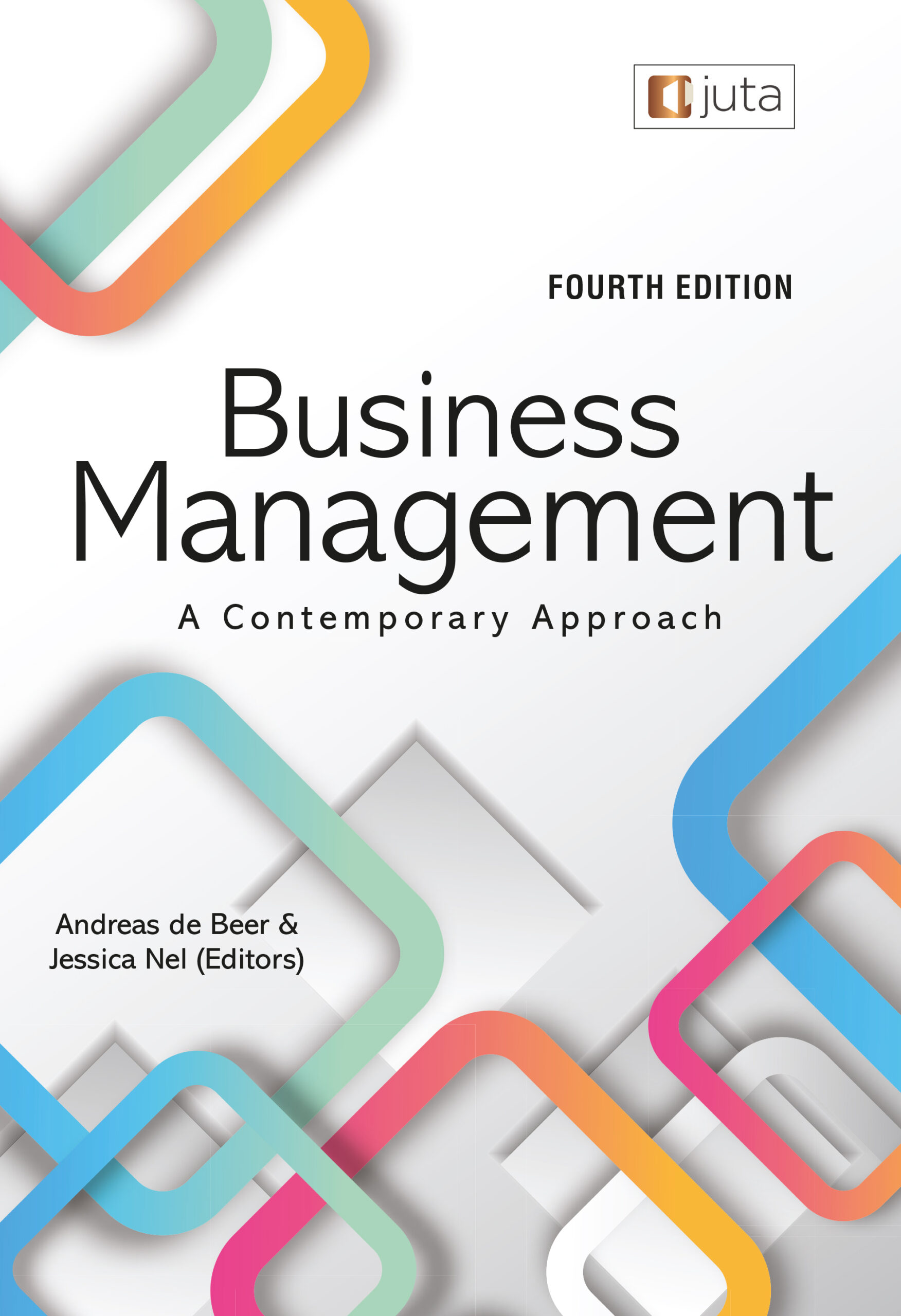


Product Details:
Author(s):
de Beer, A and
Nel, J
Year Published:
2022
Edition
4th Edition
Type:
Print | Soft Cover
Language:
English
About this publication
No business exists in a vacuum – it is impacted on by a constantly evolving world, which presents new challenges and opportunities every day. To cope with these, a business should be proactive and adaptive, not just at an operational level, but at a functional and strategic level as well. There are 12 chapters in Business Management: A Contemporary Approach focuses specifically on the functions of the business organisation and how to respond to changes in the micro-, and macro-environment, and in the market.
An introduction to the field of business management orients the reader, followed by general management principles applicable to any business manager. The book goes on to cover the various functions of the business organisation: financial management; credit management; information management; public relations; operations management; marketing management; human resource management; and purchasing management in supply chain management. It also covers contemporary issues like corporate citizenship and trends and changes in internationalisation. The third edition of Business Management: A Contemporary Approach includes new features and updated content, such as:
New case studies applying theory to practical situations
Experiential exercises and multiple-choice questions NEW FEATURE?
Up-to-date theory on the functions of the business organization
In-depth analysis of the relevant issues of corporate citizenship, globalisation and international trade.
This book will equip readers with a general understanding of the divergent internal functions of the business organisation and the interrelationships between and among these functions. The readers will also be equipped with the necessary competencies (knowledge, skills and values) to perform the tasks and roles of a manager in any functional area of a business. At the end of each chapter, there are questions for self-assessment. By answering these questions, you will get an idea of whether you have mastered the chapters.
Content
Chapter 1: What is Business Management? – Andreas de Beer
Introduction
The scientific framework of business management
Factors of production: methods to satisfy people’s multiple needs
Entrepreneurship and business
The business management cycle
The business environment
The value-chain approach
About this book
Summary
Self-evaluation
References
Chapter 2: General Management – Prof. Tersia Botha
Introduction
Definition of management
Managerial skills
Managerial levels
Areas of management
Creative problem solving, decision making and information management
Management functions (tasks)
Interaction of general management with other business functions
Summary
References
Chapter 3: Financial Management – Dumisani Mabasa
Introduction
The core principles of financial management
Value-chain analysis for growth and profitabilit
Financial statements
Financing organisation needs
Financial decisions
Financial management and other organisational functions
Summary
Self-evaluation
Addendum 1
Chapter 4: Credit Management – Dumisani Mabasa
Introduction: the background development of credit
The credit management function
Credit management in practice
Summary
Self-evaluation
References
Chapter 5: Corporate Social Responsibility – Prof. Gerrit van der Waldt
Introduction
CSR context and conceptualisation: the ‘what?’
CSR applications: the why?
CSR applications in business: the ‘how?’
Summary
Self-evaluation
References
Chapter 6: Information Management – Dr Edmund Ferreira
Introduction
The role of information management and the information manager within a business
Information systems
Communicating information
Communication format
Summary
Self-evaluation
References
Chapter 7: Public Relations – Daniel B Tshabalala
Introduction
Definition of public relations
The role of public relations
Affiliation
What are publics?
Corporate image of a business
Objectives of public relations
The requirements of successful public relations
The role of communication in public relations
The public relations process
Instruments of public relations
Media for conveying public relations messages
Interaction between public relations and other business functions
Summary
Self-evaluation
References
Chapter 8: Operations Management – Prof. Rigard J Steenkamp
Introduction
Operations management is dynamic
Operations management defined
Operations strategy and operations design
Operations planning and control
Operations improvement
Operations and the other functions of the business
Summary
Self-evaluation
References
Chapter 9: Trends and Challenges in Internationalisation in Contemporary Management – Prof. René Pellissier
A changing global business world
Globalisation and internationalisation
Internationalisation in a business context
Risks
Developing a global business strategy
Managing internationalisation and the international business
Challenges in internationalisation in a business context
Models and approaches in internationalisation
What does it take to be successful in internationalisation?
The impact of internationalisation
Future trends in internationalisation
Summary
Self-evaluation
References
Chapter 10: Marketing Management – Prof. Mike Cant
Introduction
The marketing landscape
Consumer behaviour
Marketing research
Market segmentation and target marketing
The marketing mix
Product life cycle
Marketing control and implementation
Relationship between the marketing function and the other business functions
Summary
Self-evaluation
References
Chapter 11: Human Resource Management – Trevor Amos
Introduction
Definitions and scope of human resource management
Human resource management in the business context
Implementing HRM strategy: the HRM functional value chain
Human resource service delivery
Summary
Self-evaluation
References
Chapter 12: Purchasing Management in Supply Chain Management – Prof. Hannie Badenhorst-Weiss
Introduction
Purchasing as part of supply chain management
Suppliers – the most important responsibility of purchasing
The formation and management of strategic supplier alliances
The use of information technology to integrate supply chains
Sustainability in purchasing and supply
Summary
Self-evaluation
References
Index
Interest / Benefit to
Students and lecturers
Project managers
Organisations
Be the first to review “Business Management: A Contemporary Approach”
Related products




Reviews
There are no reviews yet.