

Product Details:
Author(s):
Maree, JG
Year Published:
2012
Edition
1st Edition
Type:
Print | Soft Cover
Language:
English
About this publication
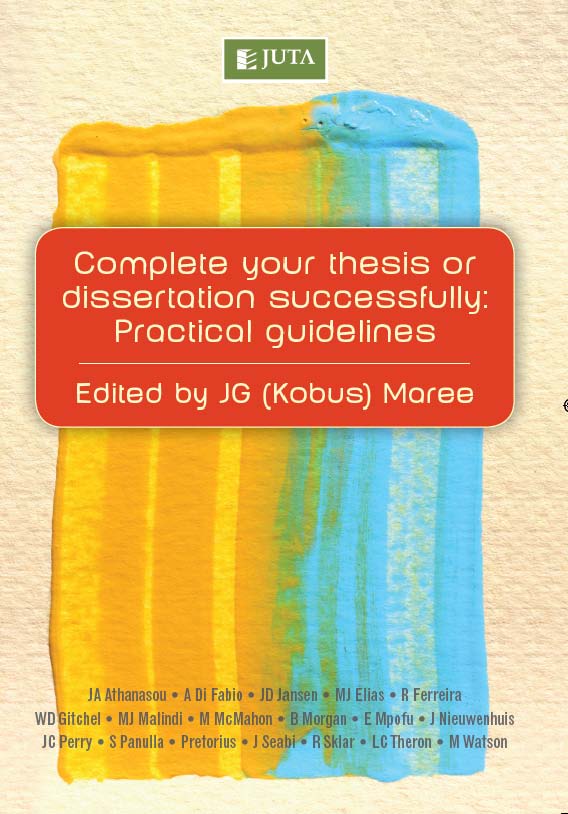
Complete your thesis or dissertation successfully: Practical guidelines provides fundamentally important information to students of the social sciences completing their master’s or doctoral studies, as well as to their supervisors and study leaders. Eminent scholars have contributed to the book and have created a text that is easy to read and use, yet does not water down the conceptual and terminological complexities of the process. For the very first time the most recent and current perspectives on how to complete master’s or doctoral studies have been brought together in one publication that will equip relatively inexperienced researchers to write a thesis or dissertation.
Current, practical, South African, up-to-date, cross-disciplinary, the book includes numerous examples of best practice, provides research sites to consult and includes a chapter on article writing.
Content
Chapter 1: The quality of doctoral education in South Africa: A question of significance
by Jonathan D Jansen
Introduction
The quest for significance in doctoral research
Kinds of significance
Chapter 2: Planning your thesis: Systemic and personal issues
by Mark Watson and Mary McMahon
Introduction
Systemic issues: choosing an institution for your research
Systemic issues: choosing a supervisor for your research
Systemic issues: you as a postgraduate researcher
Procedures for managing systemic issues
Chapter 3: Choosing a topic
by Gertie Pretorius and Brandon Morgan
Introduction
Choosing a topic
Narrowing down the topic
Technical support with regard to choosing a topic
The researcher’s capabilities
Is the research original?
Matching the topic with the research method
Practical tips and suggestions
Chapter 4: Writing a research proposal
by Ronél Ferreira
Introduction
Purpose of a research proposal
Components of a research proposal
Practical guidelines for writing a research proposal
Chapter 5: Theoretical-conceptual and structural aspects of thesis writing
by James A Athanasou, Elias Mpofu, W Dent Gitchel and Maurice J Elias
Introduction
Conceptual framework
The research question
The importance of structure
Should one follow a particular structure?
Chapter 6: Basic issues in thesis writing
by W Dent Gitchel and Elias Mpofu
Introduction
The research premise
The research paradigm
Methodological assumptions
The SWH model
How to approach the thesis-writing process
Chapter 7: Sampling and research paradigms
by Brandon Morgan and Rony H Sklar
Introduction
Sampling
Research paradigms
Quantitative research
Qualitative research
Mixed-methods research
Fixed reality and multiple realities: the ontological shift
Chapter 8: Research designs and data collection techniques
by Joseph Seabi
Introduction
Research designs
Types of research designs
Data collection techniques
Chapter 9: Conducting qualitative research: Practical guidelines on fieldwork
by Linda C Theron and Macalane J Malindi
Introduction
Planning your fieldwork
Doing fieldwork
Following up on your fieldwork
Chapter 10: Writing the quantitative research method chapter
by Brandon Morgan and Rony H Sklar
Introduction
The components of a research method chapter
The introduction
Aims
Quantitative research strategy and design
Participants
Research instruments/measures/data collection instruments
Research procedure
Data analysis
Ethics in quantitative research
Conducting quantitative research fieldwork: guidelines
Chapter 11: Conducting mixed-methods research
by Justin C Perry
Introduction
What is the mixed-methods approach?
Why do mixed-methods research?
Illustrative examples
Guidelines for writing a mixed-methods thesis
Chapter 12: Ensuring quality in scholarly writing
by Annamaria Di Fabio and JG (Kobus) Maree
Introduction
The recording of sessions between supervisors and students
Quantitative approaches Validity
Qualitative approaches
Data analysis in qualitative research
Trustworthiness
Triangulation
Crystallisation
Triangulation or crystallisation? Or both?
References
Chapter 13: Linking purpose and ethics in thesis writing: South African illustrations of an international perspective
by Maurice J Elias and Linda C Theron
Introduction
Alternative contributions that a thesis can make
Ethical principles
Informed consent
Inclusion of university/college students as experimental participants in research
Assessment of risks and benefits
Equitable selection of participants
Endnotes
References
Appendix 13.1: Sample informed consent letter
Chapter 14: Writing style
by JG (Kobus) Maree
Introduction
General aspects of writing style in theses
Basic linguistic and stylistic guidelines
Common areas of error
Chapter 15: Communication between student and supervisor
by Gertie Pretorius
Introduction
Finding a potential supervisor
The roles and responsibilities of the student
The roles and responsibilities of the supervisor
The research contract
Communication and conflict
Conclusion
Endnote
References
Appendix 15.1: An example of a supervisor–student contract
Chapter 16: The role of critical readers in postgraduate studies
by Jan Nieuwenhuis
Introduction
What is critical reading?
What is meant by the term ‘critical review’?
What does it take to be a good critical reviewer?
When to involve critical readers
The critical review process
Chapter 17: Examining a thesis and writing an examiner’s report
by JG (Kobus) Maree
Introduction
Generic aspects of thesis examination
Failing a candidate
Criteria for evaluating a thesis
Appendix 17.1: Template for evaluation
Appendix 17.2: Example of an examiner’s report
Chapter 18: Choosing examiners for a thesis or dissertation
by JG (Kobus) Maree
Introduction
Why are examiners’ reports so important?
Should national (local) or international examiners be appointed to examine theses?
The nature of examiners’ reports
Whom to appoint as examiners
Ensuring a fair examination process
Chapter 19: How to prepare for an oral doctoral examination
by JG (Kobus) Maree
Introduction
Procedure for an oral examination
Why an oral examination?
Components of an oral defence
Structure of an oral defence
Possible questions during an oral defence
Chapter 20: The ultimate aim of your studies: Getting a manuscript published
by JG (Kobus) Maree
Introduction
Why write manuscripts?
Essential information before you start writing
Why some people get their manuscripts accepted while others do not
Shedding light on why you wish to get published
Deciding on a topic
The title of your manuscript
Identifying an appropriate journal
Preliminary aspects of article writing
Writing the body of the text
Drawing up a brief checklist that can help you decide whether your manuscript is ready for submission
Role of critical readers
Preparing the manuscript for submission: meeting language and technical requirements
Submitting your manuscript
Appendix 20.1: List of possible reviewers’ comments
Chapter 21: Electronic submissions to journals
by JG (Kobus) Maree and Sharon Panulla
Do scholarly articles with open access status attract more citations than those without?
Submitting manuscripts online
Interest / Benefit to
Students of the social sciences completing their master’s or doctoral studies, as well as to their supervisors and study leaders.
Be the first to review “Complete Your Thesis or Dissertation Successfully”
Related products
Reviews
There are no reviews yet.