

Product Details:
Author(s):
Chirwa, J
Year Published:
2020
Edition
1st Edition
Type:
Print | Soft Cover
Language:
English
About this publication
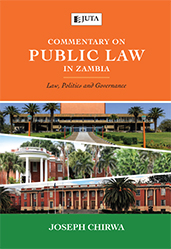
This is a no-holds-barred commentary on public law in Zambia that considers good governance, politics and human rights. Evoking the spirit and style of eminent law writers such as Sir Blackstone and Lord Denning, the author presents a commentary on cardinal issues in public administration and law in a provocative yet informative way.
Commentary on Public Law in Zambia: Law, Politics and Governance covers a wide range of subjects from constitutionalism to human rights, democracy to good governance, executive authority to judicial independence, parliamentary practice and procedure to the office of the Public Protector, and more, in the course of its sixteen chapters.
Joseph Chirwa shows himself to be the future of legal scholarship and writing in Zambia, learning from the best Zambia has produced, among others Professor Muna Ndulo, Supreme Court Justice Mumba Malila, SC and retired Justice Patrick Matibini, SC.
The book deals with the following topics:
constitutional theory and practice
judicial independence
parliamentary procedure and practice
the Public Protector
proceedings against the state
the politics of state-owned enterprises
the executive authority
judicial review
the electoral process
institutions of good governance
constitutional protection of human rights
environmental law and policy
contempt of court
public interest litigation
the tribunal system
commissions
Content
DEDICATION
ABOUT THE AUTHOR
FOREWORD
PREFACE
ACKNOWLEDGEMENTS
TABLE OF CASES
TABLE OF LEGISLATION
CHAPTER 1: CONSTITUTIONAL THEORY AND PRACTICE
1.1 Constitutionalism and supremacy of the Constitution
1.2 Rule of law
1.2.1 Government under law
1.2.2 Equality before the law
1.2.3 Discretion and the rule of law
1.3 Separation of powers and checks and balances
1.3.1 Separation of powers: reality or myth?
1.3.2 Of checks and balances
1.4 Good governance and democracy
CHAPTER 2: JUDICIAL INDEPENDENCE
2.1 Conceptualising judicial independence
2.2 From whom should the judiciary be independent?
2.3 Facets of judicial independence
2.4 Accountability of the judiciary
2.5 The Judicial Code of Conduct
2.6 The judiciary and human rights
2.7 The judiciary and politics
CHAPTER 3: PARLIAMENTARY PROCEDURE AND PRACTICE
3.1 National Assembly or Parliament?
3.2 The Speakership
3.2.1 Administrative functions
3.2.2 Institutional functions
3.3 Leader of Government Business
3.4 Leader of the Opposition
3.5 The Government Chief Whip, Deputy Chief Whip and Party Whips
3.6 Clerk of the National Assembly
3.7 Committee system
3.7.1 House-keeping committees
3.7.2 General purpose committees
3.7.3 Portfolio committees
3.8 Powers and privileges
3.8.1 Parliamentary immunity
3.8.2 Parliamentary privilege
3.8.3 Parliamentary power
3.9 Controls on administrative actions
3.10 The law-making process
3.10.1 First reading
3.10.2 Second reading
3.10.3 Committee stage
3.10.4 Report stage
3.10.5 Third reading
3.10.6 Presidential assent
CHAPTER 4: THE PUBLIC PROTECTOR
4.1 History
4.2 Rationale
4.3 Functions
4.4 Remedies
CHAPTER 5: PROCEEDINGS AGAINST THE STATE
5.1 Should proceedings be entered against the ‘state’ or the‘government’?
5.2 Liability of the state in tort
5.3 Liability of the state in contract
5.4 Criminal liability against the state?
5.5 Immunities of the state
CHAPTER 6: THE POLITICS OF STATE-OWNED ENTERPRISES
6.1 Legal basis for state-owned enterprises
6.2 Rationale and objectives of public enterprises
6.3 Types of public enterprises
6.3.1 Departmental undertaking
6.3.2 Joint stock company
6.3.3 Public corporation
6.3.4 Holding company
6.4 Corporate governance
6.4.1 Minister-in-Charge of Portfolio
6.4.2 Industrial Development Corporation
6.4.3 Board of Directors
6.4.4 Executive management
6.5 Accountability and control
6.5.1 Parliamentary control
6.5.2 Judicial control
6.5.3 Ministerial control
6.5.4 Control through audit
6.5.5 Internal controls
CHAPTER 7: THE EXECUTIVE AUTHORITY
7.1 The foundation of the executive authority
7.1.1 What is the executive?
7.1.2 Authority
7.1.3 Power
7.2 Theories of executive power
7.2.1 The residual power theory
7.2.2 The inherent power theory
7.2.3 The specific grant theory
7.3 The Presidency
7.4 The Vice-President
7.5 The Cabinet
7.5.1 Cabinet meetings
7.5.2 Cabinet committees and their functions
7.5.3 Principles of Cabinet
7.6 Ministers
7.7 Provincial Ministers
7.8 The civil service
7.8.1 Principles governing the civil service
7.8.2 Code of Ethics
7.9 Defence and security
7.9.1 Defence force and functions
7.9.2 National security services and functions
7.10 Local government
7.11 Regulatory agencies and advisory bodies
CHAPTER 8: JUDICIAL REVIEW
8.1 Nature
8.2 Scope
8.3 Public bodies for the purpose of judicial review
8.4 Requirement of locus standi
8.5 Grounds for judicial review
8.5.1 Illegality
8.5.2 Procedural impropriety
8.5.3 Unreasonableness
8.5.4 Proportionality
8.6 Legitimate expectation and the future of judicial review
8.7 Remedies under judicial review
8.7.1 Certiorari
8.7.2 Prohibition
8.7.3 Mandamus
8.7.4 Declaration
8.7.5 Injunction
8.7.6 Damages
CHAPTER 9: THE ELECTORAL PROCESS
9.1 Elections and public participation
9.1.1 Who is eligible to vote?
9.2 Electoral institutions
9.2.1 Electoral Commission of Zambia
9.2.2 High Court and Constitutional Court
9.2.3 Local Government Elections Tribunal
9.2.4 Civil society organisations
9.2.5 The international community
9.2.6 The media
9.3 Electoral systems
9.3.1 Understanding the 50 percent plus 1 vote threshold
9.3.2 First-past-the-post
9.3.3 One-member constituency and ward
9.4 Electoral offences, malpractice and tribalism
9.4.1 Article 45 principles
9.4.2 Section 3 principles
9.4.3 Electoral offences and malpractices
9.4.4 Is tribalism the new norm and future of Zambia’s electoral system and process?
CHAPTER 10: INSTITUTIONS OF GOOD GOVERNANCE
10.1 The free press
10.2 Pressure groups
10.3 Political parties
10.4 Trade unions and the labour movement
10.5 The church
10.6 Traditional authorities
10.6.2 Chiefs as councillors
10.6.3 The House of Chiefs
10.7 Students and the intelligentsia
CHAPTER 11: CONSTITUTIONAL PROTECTION OF HUMAN RIGHTS
11.1 Conceptualisation of human rights
11.1.1 Human rights are universal and inalienable
11.1.2 Human rights are interdependent and indivisible
11.1.3 Human rights are to be applied equally and without discrimination
11.1.4 Human rights entail both rights and obligations
11.1.5 Human rights are distinguishable from other rights
11.2 Source of human rights
11.2.1 Natural law theory
11.2.2 Positivist theory
11.2.3 Social contract theory
11.3 The Zambian Bill of Rights
11.3.1 What is the Bill of Rights?
11.3.2 What are the advantages of having rights enshrined in the Constitution?
11.3.3 Contents of the Bill of Rights
11.4 National protection of human rights
11.4.1 Courts of law
11.4.2 Human Rights Commission
11.4.3 Public Protector
11.4.4 Police Public Complaints Commission
11.5 International protection of human rights
11.5.1 The African Commission on Human and Peoples’ Rights
11.5.2 United Nations Commission on Human Rights
CHAPTER 12: ENVIRONMENTAL LAW AND POLICY
12.1 Conceptualisation of environmental law
12.2 Scope of environmental law and policy
12.3 Values, principles and environmental law
12.4 The administrative machinery of environmental law and policy
12.4.1 The Ministry responsible for Lands, Environment and Natural Resources
12.4.2 The Zambia Environmental Management Agency
12.4.3 Local authorities
12.4.4 Courts of law
12.4.5 Other departments and agencies
CHAPTER 13: CONTEMPT OF COURT
13.1 When is one in contempt of court?
13.1.1 Purposes and rationale for contempt laws
13.1.2 Are courts immune to criticism?
13.2 Civil or criminal contempt?
13.3 Facets of contempt
13.3.1 Contempt in the face of the court
13.3.2 Publications interfering with the due course of justice
13.3.3 Acts which interfere with the course of justice
13.4 Procedure and practice
13.5 Jurisdiction and powers of the courts
CHAPTER 14: PUBLIC INTEREST LITIGATION
14.1 Origins of public interest litigation
14.2 Subject matter of public interest litigation
14.2.1 What is public interest?
14.2.2 What is public interest law?
14.2.3 What is public interest litigation?
14.3 Judicial activism
14.4 Social action litigation and social justice
CHAPTER 15: THE TRIBUNAL SYSTEM
15.1 The concept and idea
15.2 The case for tribunals
15.3 Examples of tribunals
15.4 The new norm?
CHAPTER 16: COMMISSIONS
16.1 Commissions under the Service Commissions Act
16.1.1 Rationale
16.1.2 Principles governing commissions
16.1.3 Financial independence
16.1.4 General powers of commissions
16.1.5 List of commissions
16.2 Commissions under the Inquiries Act
INDEX
Interest / Benefit to
Be the first to review “Commentary on Public Law in Zambia”
Related products

Reviews
There are no reviews yet.